Why do they buy it, if they aren't going to use it?

If you work in accounting technology, you've probably asked yourself this question more than once.
You've built a good product. You've got a compelling case study or two. Practices sign up. And then - not much happens. The practice goes quiet. Usage is low.
It's tempting to put it down to accountants being resistant to change.
But that's not true.
In my experience, there are real, knowable reasons why this happens.
Let me share one of the biggest ones.
The buyer and the doer are living in completely different worlds.
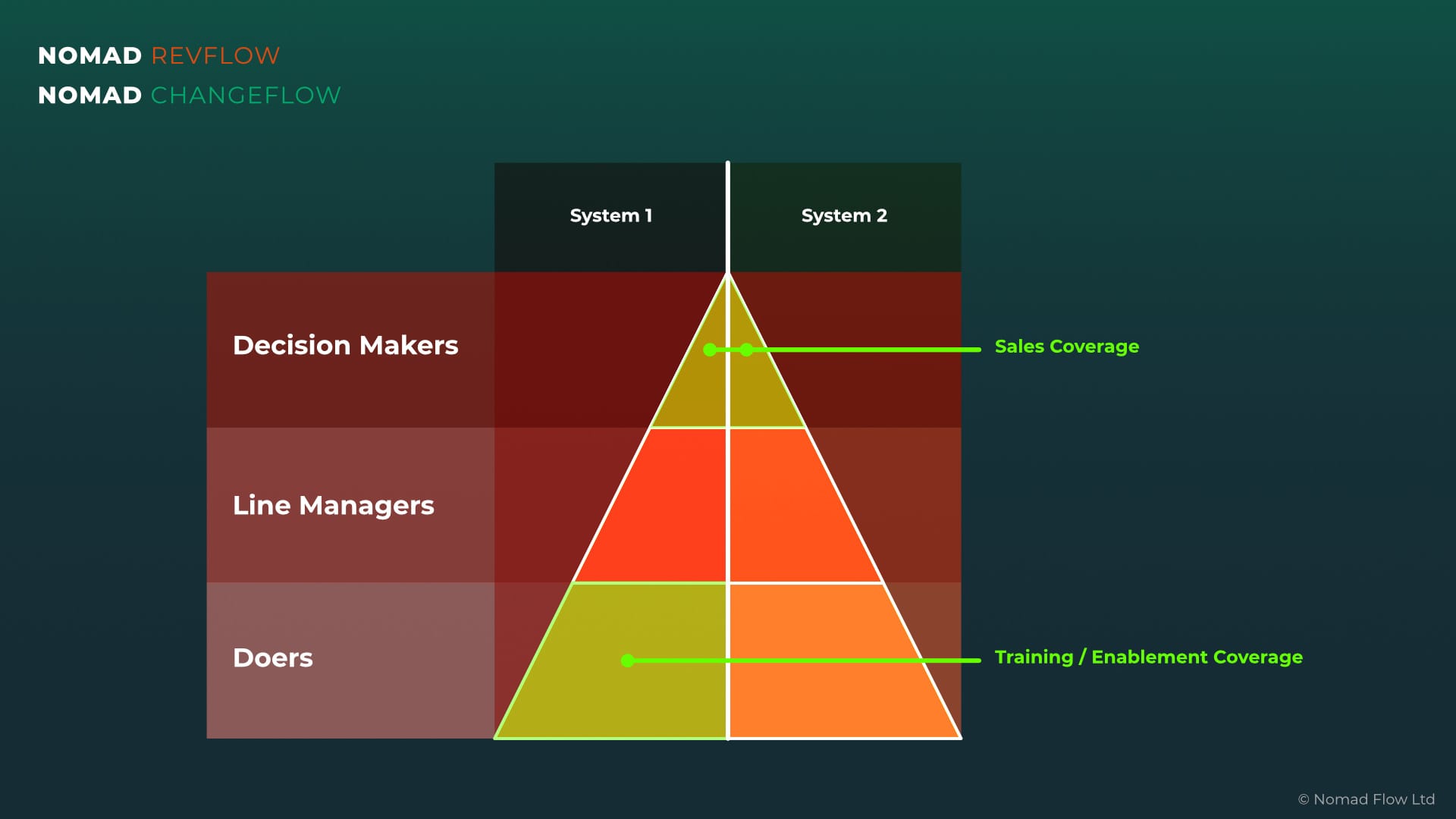
When your sales team gets in front of a decision maker, they do what good salespeople do.
They diagnose the pain and quantify it - financially and emotionally.
"What would it mean to you if you no longer had to worry about X?"
They speak to both the gut feeling and the logical justification - the excitement of possibility, the discomfort of pain - and the reassurance of an ROI.
Daniel Kahneman's Thinking, Fast and Slow describes two modes of thinking:
- System 1, which is fast, intuitive and emotional, and
- System 2: which is slow, deliberate and analytical.
A well-run sales process looks after both. The senior partner or director leaves the meeting feeling good about the decision and able to defend it rationally.
But here's where things go wrong.
The person who bought the software is rarely the person who has to use it every day. That person - the senior accountant, the accounts manager, the bookkeeper - are often absent at this stage.
They didn't feel the excitement. They just found out that from Monday, things are going to work differently.
To understand why this matters, you need to understand something about the environment these people work in.
Accounting and bookkeeping firms take a very wide range of inputs - client data in every format imaginable, varying levels of complexity, unpredictable timing - and work to produce standardised, compliant outputs.
These folks have to do this, do it well and do it reliably.
Month after month.
Quarter after quarter.
Year after year.
So they create habits. Processes that work. Ways of doing things that have become so familiar they barely need to think about them.
Noel Burch's four stages of competence describes this as 'unconscious competence' - the point where a skill is so well-practised it becomes automatic. For an accountant or bookkeeper their existing software workflow often sits right here. They're not thinking about it. It's an extension of themselves.
And they're using the cognitive headroom that's saved to effectively operate within the often chaotic environment that exists within these firms. Balancing workloads, deadlines, manager and client demands.
Then your new software arrives.
Overnight, they go from 'unconscious competence' to 'conscious incompetence'.
They know what they need to do - complete work for a client - but the familiar path is gone. Every step requires active thought. Where's that button? How does this workflow work? Why isn't it doing what I expect?
It's tempting to label this as laziness, or 'resistance to change'.
But it's not. Not always.
This is a predictable, well-documented cognitive experience. And it lands on a team whose System 2 is already depleted just from doing their day job.
Kahneman describes a law of least effort:
When there are several ways to achieve the same goal, people will gravitate towards the least demanding course of action.
The key word there is goal. The goal is not to use your software correctly. The goal is to get the client's work done. And right now, your new platform is the path of most resistance.
So they default back. Not because they're difficult, but because their brain is doing exactly what brains are supposed to do.
This is nobody's fault - but it is a blind spot.
The sale and the adoption are designed for completely different cognitive states. One is built around inspiration and logic. The other dumps people into confusion with a login and training resources.
And what do most vendors do to 'ease' the transition? Training courses and Help Centres.
Inadvertently placing more demand on an already overwhelmed System 2 - making the problem worse.
Nobody planned it that way. It's a structural gap - between the world of the buyer and the world of the doer. And until you can see it clearly, you can't do much about it.
The good news is that there are real levers you can pull to reduce the friction, build momentum, and actually get people to the other side of that learning curve.
That's what we'll get into next time.
AI Disclaimer: AI helped me to organise my thoughts on this, prepare a first draft and then proof-read my final draft. The header image is also AI generated.
Leigh Stallard is the founder of Nomad Flow, a consultancy helping accounting tech close the gap between sign-up and genuine adoption. If this resonates, you can subscribe to Mind the Gap below.