Schrodinger's SaaS
"SaaS is Dead"
"SaaS isn't Dead!"
SaaS is currently in a very interesting place. It concurrently faces enormous threats and enormous opportunity - and the only thing that's certain at the moment is uncertainty. That, and that not all SaaS is born equal.
We can assess a SaaS's long term market prospects by answering two questions.
1 - Are they a feature or a platform?
Some SaaS 'products' are actually 'features-with-a-subscription'.
Some may have been built with the intention of being bought by a bigger player. Some are laser focused on a specific need. This isn't necessarily a bad thing - doing one thing really well is commendable and needless feature-stuffing is not a good strategy.
But.
In a noisy marketplace, with an increasing scrutiny over tech spend and 'login fatigue' setting in - these apps will have to fight harder to justify their place in the toolkit.
Conversely, some SaaS players are platforms.
They provide multiple features, incorporating multiple touch-points across an extended workflow. They can also form hub to allow the user to connect into other products via APIs or, increasingly, MCPs.
The downsides of platforms are that they usually cost more - especially when considering the ongoing training burden to stay up to date with changes.
It's usually not one or the other - most apps will sit somewhere between both extremes.
2 - Are they embedded or adjacent?
Truly embedded systems ARE the workflow. Or they're so ingrained as to be indistinguishable from it.
For example - Xero, FreeAgent, Sage IS the bank rec process for their customers. Ripping out this system means reworking the process entirely.
Some apps function alongside a workflow. They're tacked onto an existing process to make it quicker, easier or improve it in some other way.
As an example - the egg timer on my desk is adjacent to my productivity workflow. It helps, but it sits alongside.
My project management system is embedded. My egg timer is adjacent.
Also notable here are tools which should be embedded, but haven't yet been fully embraced or adopted by the team who'll use them.
This may be because the tool is still new, or because it's failed to achieve widespread activation. Either way, the tool isn't yet 'mission critical'.
So what?
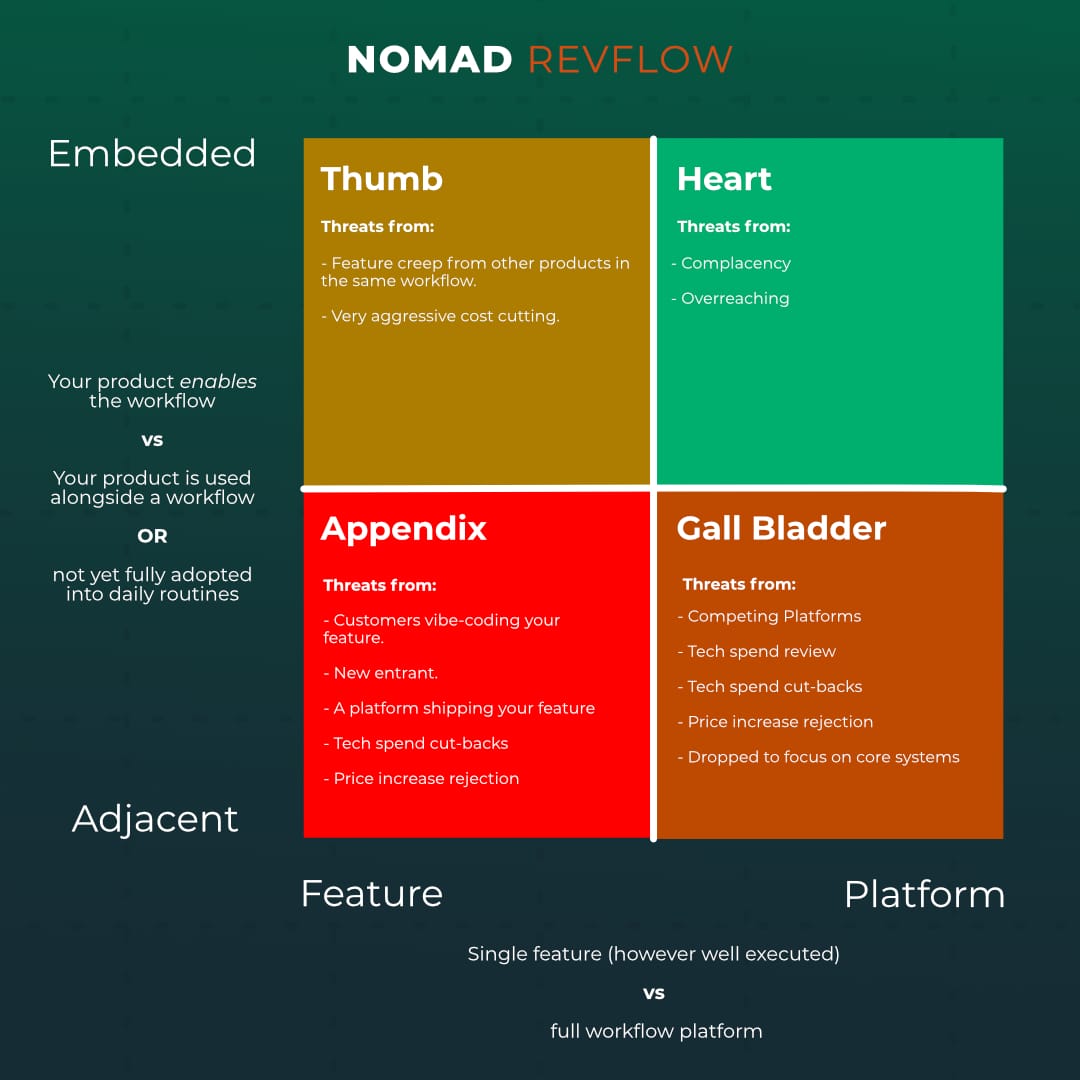
Based on these answers, we can plot the app on the below graph.
The quadrant they land in helps us to identify the specific threats those apps may face. I've characterised them as follows to illustrate their impact and the consequence of their removal or replacement.
Heart
Critical to the system. Not impossible to replace - but very difficult, requiring significant surgery.
Embedded platforms are the titans of this space at the moment.
These products become the threats to others as they push for greater revenue per users. They can add more features to suck up more of the workflow from other vendors.
Example = Xero in a Xero-only firm. They own the workflow, the data and the habits of the users.
Thumb
Loss would be painful - but the system will broadly still be able to function. Some workflows will break, but that can either be accepted or worked around with certain accommodations.
These are solid tools, often patching gaps that the platforms aren't able to fill. Sometimes quite niche.
They add value at the organisation level, not just for individuals.
Example = properly-implemented A2X for ecommerce businesses. They facilitate a very specific part of the workflow.
Gallbladder
"The what?" is exactly the right response. Actually a very capable and beneficial system, but is usually overlooked. The loss of it is better expressed as a loss of potential opportunity, rather than an adverse impact on the day-to-day function.
These are large, capable platforms which - for whatever reason - haven't taken hold. Therefore the very real benefit of the full platform isn't felt - so neither is the loss of it.
These can be systems which are held 'in reserve' in case they're needed - however their complexity can become a liability because the upkeep / ongoing training becomes an ongoing cost.
Example = Xero Partnership in a FreeAgent-centric practice. Sits in the background until it's needed.
Appendix
Serves a very specific, very niche function but its loss can be adapted to quite easily. It's worth keeping - mostly because removing it is inconvenient - until it either causes a problem or gets in the way.
These are simple, straightforward apps which do one thing well. They usually benefit an individual rather than the organisation and they will smooth or improve a workflow rather than facilitate it.
Example = Mileage tracking app. Nice to have. Mildly inconvenient to get rid of it.
Threat levels
As you can imagine, each quadrant is currently at different levels of threat.
If customers decide to cut costs (and cancel subscriptions), they'll do so in this order:
1) Appendix Can be worked around or staff will have to revert to a manual process. Little impact to the business.
2) Gallbladder Removes the ongoing over head of training and cost and allows refocusing on core systems and processes.
3) Thumb The first cuts that begin to really hurt the organisation. Necessary if steps 1 and 2 haven't produced the required savings.
4) Heart Last resort to either cut back on this system or move it to an alternative. Internal disruption caused is unlikely to outweigh anything but major cost savings.
So - is your SaaS dead?
If you're nestled firmly in the very bottom left corner of the graph above - then I have bad news for you.
But you probably already know that.
In fact, anywhere at the bottom level of the graph makes you - to a degree - expendable.
Some vendors are trying to move from the left to the right by releasing more features and expanding across more of their customers' workflow and become more indispensable.
However, as we've explored, moving to the right isn't enough, if you're still near the bottom of the graph.
Most vendors I speak to think they're a Thumb.
Their activation data usually tells a different story. Three minutes in our onboarding healthcheck might be the most uncomfortable - but beneficial - thing you do this week.